Thursday, November 4, 2010
Post-Recession Start-Ups
It seems almost like a distant memory now to think of the events that unfolded in the summer of 2008. Following Bear Stearns, banks and financial institutions fell like dominoes as our DOW plummeted. Business as we knew it would never be the same.... and it hasn't been.
I remember when I was young, growing up on the farm, every two to three years, in the fall, my dad and I would start controlled burns of the long, dying grass in water-ways and ditches. At the end of the day, the entire area was covered in black ash, and you could hardly believe this was once a grassy plain. But the following spring, the new shoots that arose where the old grass had been burned were thicker, stronger, and greener than ever.
In the post-recession ashes of our economy, an interesting phenomenon is taking place--one that will shape our economy for the decades to come. Over 200,000 new businesses were formed in the U.S. in just the first half of 2010 alone. That's a 50% increase over 2008 and 2009. In the ashes of dead businesses, green shoots arise--stronger than ever.
And this onslaught of start-ups will not only change life for the entrepreneur or unemployed looking for opportunity. The titans of industry that survived the great recession, coming through 2008 and 2009 still competitive and operational, now face a new market that they must serve. The "whales," as salesmen used to call them, are fewer and fewer. Vendors who once survived on large kills will now need to equip themselves to fish with nets, not harpoons. Schools of start-ups will be the customer base of the future, not a few premium clients.
For the technology sector, start-ups will mean more single-seat sales, higher support load, a greater demand for self-sufficiency, and a higher number of broadband end-users plugging in. No longer will one terminal service a punch-panel that delivers broadband to 50 employees. Solopreneuers and small offices will each require discreet connections, and still expect similar performance. And, were small organizations lack in-house IT departments, much of the end-user support load will be transferred to the vendors themselves.
Cultivating, selling-to, and supporting an economy of micro-enterprise will create a new set of challenges for any business-to-business industry. How will your company adapt to this changing marketplace?
Labels: Broadband, Economy, Small Business
posted by Unknown at 5:02 AM
Link to this Article
0 Comments
###
Wednesday, September 22, 2010
Small Business Technology Needs
Almost any business-related technology on the market--broadband services, IT infrastructure, office productivity software, accounting software, CRM software , etc.--was originally designed with enterprise-level business in mind. This is not because of some unrighteous bias against mom-and-pops and the small business backbone of America. It's a simple matter of economics. As businesses form around technology innovations, the earliest adopters will be those with the budget to buy, and those are most commonly large business.
So what's the net result? When technology vendors enter the marketplace gunning for big business--looking to land a whale or two, not a thousand tiny bluegill--they inevitably tailor their solutions to attract this level of macro-enterprise. But eventually, and more rapidly of recent, technologies become affordable for micro-enterprise. The only question is: when they do, does the shoe fit?
PC's, for example, existed for decades in a business environment where most customers had an IT staff that could handle patches, upgrades, and bugs. But, as the technology became more and more affordable for small business and in-home use, the paradigm which once demanded a buyer have on-site technicians and support no longer fit. I still firmly believe that Mac's are less powerful and less adaptable in a large network environment. But, they key to their success has been the introduction of a newly re-designed solution that accommodates the unique needs of the emerging small-business and SOHO market.
Broadband is no different. As high-speed internet came available, those that could afford T1 and T3 connections made no beef about the extreme difficulty with which WAN networks could be integrated and secured. The PCI-DSS came along and really added a heavy burden, but enterprise-level buyers relied on a wealth of in-house technical resource. Today, however, broadband needs to be available to the small chains, the small businesses, and the rural offices. Accel Networks' fixed wireless broadband solution is a managed solution. From provisioning to plugging it in, Accel can manage the entire system for end-users. And, with our easy-to-use management tools, even small business owners aren't afraid to call themselves the "network admin."
The trend from big to small, from whale hunting to netting schools of small business, has happened in nearly every market since the industrial revolution. Today, small business computing, small business account software,
small business crm software, small business this and that technology are all growing wildly. What will be the next emerging technology to become affordable and usable to the small business market?
Labels: Broadband, Small Business
posted by Unknown at 4:09 AM
Link to this Article
0 Comments
###
Wednesday, April 28, 2010
Small Business Office Suites & Broadband
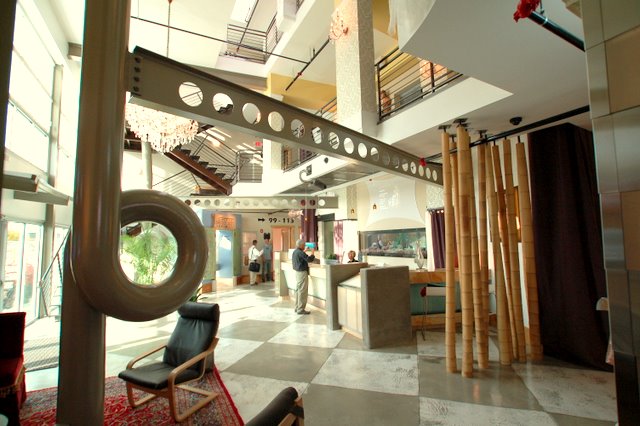
Around Indianapolis, Scott Yeager is becoming extremely well known... at least, by his last name.
Yeager Properties has become known for placing unique looking buildings, like the one to the right, in conspicuous locations around the city. The buildings are as unique inside as they are out, with wild colors, irregular contours, and a noticeably non-standard office look.
What's the point, you ask? Yeager caters to an eschelon of business tenants many commercial real estate owners hate to deal with--the young start-ups. His properties have appeal for small micro-enterprise by offering affordable small office suites for small teams, with availability for conference space and other professional services right on premise.
But complications arise when companies move in, set up a semi-permanent place of business, and then outgrow the space in a matter of years. For Scott, keeping his space leased out is obviously a concern--although his extremely recognizable brand and creatively unique space have led to waiting lists, not vacancy lists. But for the tenants themselves, the volatile stage of small business growth can have costly ramifications, too.
Years ago, I managed a new office in Indy. When we first moved out of an incubator space, where I spent less than a 6-month stint, I didn't realize the untold costs. To begin with, we needed new letterhead, new business cards, new stationary, new envelopes, not to mention new furniture and a costly move. But, you know that new line activation fee for my broadband... well, I had to pay it again. Twice in just 6 months really makes you feel it. I wish Accel Networks had been an option then.
After moving into a larger, permanent space, I have known other companies to spend weeks working from home or from Starbucks while broadband was waiting to get provisioned in the new space. So, Kudos to Scott and his enormously popular commercial office spaces for small business, but buyer beware on short-term leases. Accel Networks could save time and money for many of the small businesses.
Labels: Broadband, Small Business, Yeager Properties
posted by Unknown at 7:38 AM
Link to this Article
0 Comments
###


